Friday, June 14, 2013

Only one more week with Pratham!

I have just finished a 17 hour train journey back from Delhi... and im exhausted. 

This past week has been a challenging, and frustrating one, but also one where I have learned some good lessons. On Monday I got to office a little early like I usually do to read online articles for my research and couldn't find the word document where I had been keeping all of my notes. It just wasn't there and all the carefully saved weblinks, and bullet pointed facts in addition to the phone numbers and contacts I had carefully saved were all gone. I did everything to try and recover the file, but my computer just said it couldn't open the encrypted document. Like everyone does in this situation, I beat myself over the head for not saving my work in an online google doc or backing it up through email. But also like everyone knows, this never helps the situation. Instead, I took a deep breath dove into office work and decided to start again tomorrow. Thankfully the day got much better when my colleague, Pratyush, called my name and handed me a large stack of completed surveys that I had given him the week before.  I had been struggling to get enough people to take my survey, not to mention a diverse crowd of people, and had asked my NGO if they could send my survey to members of their field staff including teachers, tutors, administrators etc. Many of them are not very highly educated and thus with the help of my friends in the office, I had translated the survey into Marathi, the local language in Maharashtra, and handed over 80 copies. I got back 75 copies that I will be able to add to the 20 or so that I will get from my online survey, the 30 or so that I will get from the office and the 25 or so that I got while harassing people in the mall. This news greatly improved my day and I tried to stay positive and remind myself that all the work I lost can be recovered.

I didn't have much time to start on the research again the following day because my team and I prepared to leave for Delhi. We were getting on the train that night and would arrive in Delhi the next day in the afternoon. My NGO graciously paid for my train ticket because it was a work trip, and I quickly prepared the Delhi surveys that I hoped to get filled out while I was visiting the Pratham, Delhi office. The 3 day trip was a success and I returned home with about 30 Delhi surveys filled out and a lot more knowledge about interoffice politics. Throughout this entire month working with Pratham I have learned some valuable skills when it comes to working with other colleagues, especially ones who are older and more experienced. I have also observed how toxic a disliked member can be for the rest of the team. I have loved getting to know the colleagues in my office in Mumbai, and their passion for what they do inspires me everyday.  Even though I haven't been able to get out into the field as much as I would have liked, I have made the most of my time in the office. Below is a picture of me with my colleagues after we all went out for lunch.


Sunday, June 9, 2013

 4 down, two 2 go.

Spending a month in India has not been akin to spending a month anywhere else. It goes by…really fast. I have come to the realization  that I came to India at an impeccable time in relation to the progresses the rickshaw pulling sector in Bihar has been taking. About a week ago, the Chief minister of Bihar announced that the state government is going to launch a Rickshaw Puller cooperative sheme that is going to affect at least 7.5 million people statewide. The considerable success of organizations such as Sammaan and others working with the rickshaw pulling sector have proved that there are viable solutions to be applied to the current condition that Bihar’s 1.5 million rickshaw pullers and 6 million dependents persist in.
Not only has the government adopted this innovative shceme but they plan to get it up and running in time for an official launch on Muhatma Ghandi’s birthday on October 2nd. With this being said,  Sammaan has gotten straight to work having been given the duty of helping develop a comprehensive draft proposal for the cooperative scheme and an additional presentation for a meeting soon with the Chief minister of Bihar this coming week. This week has been quite hectic as I’ve been given the privilege to help out with the proposal and more especially with the powerpoint presentation that will have to look attractive and engaging for the Chief minister. It has been an awesome learning experience participating in such a potenitally massive step for the state. This current project has allowed me to see how dedicated  the Sammaan staff are to their work for the sake of the rickshaw pullers. In spite of this,  I would’ve preferred to have had more time spent to continue with data collection from the rickshaw pullers. Accessing the rickshaw pullers has been quite a difficult since they are also hard at work during the day as they are all around town making a living. As much as I would hate to interrupt their schedule, this week will be spent trying to get into contact with as many of them as possible to get direct testimonials and information regarding the strides they have been making with the new resources, opportunities and services they have access to through the Sammaan program. So this next week should fly by quickly once again with lots to do. I plan to complete my data collection and spend the next 2 weeks moulding my investigation to suit the resources that I will have the most access to with the short time I have left. 
Today, a member from the church I've been attending here in Patna invited me for his son's birthday get-together. Here is a photo with some of the kids present at the party. The hospitality was sheer brilliance, a really heart-warming (and stomach-filling) experience.

Sunday, June 2, 2013

A week on the ground

This week was very stimulating having conducted my first proper field visit to witness some of the ground work Sammaan Foundation has been doing and to get a chance to interact with the beneficiaries i.e. the rickshaw pullers under the program. Most of the field visit however, was spent observing. In order to truly understand the existing need for intervention and change of the condition of Patna’s rickshaws pullers, I had to first realize the initial condition in which many rickshaw pullers persist. Being migrants from the rural districts, these pullers do not have the right circumstances to gain suitable housing while they work in Patna. As a result, we found multiple pullers, some with families, camping by the roadside, having pitched temporary tents and made for themselves an operational livelihood. This is where they reside when they are not working and they are often forced to relocate by the police, as there camps are not fit for the site of some politicians who may drive by these same roads.
Rickshaw puller camps by the side of one of Patna's main roads

The state government had however, intervened a decade ago and managed to build night shelters for the rickshaw pullers. These shelters meet the bare minimum need of protecting them from the rain and much less. With the increasing number of rickshaws in town, these shelters can only hold so many rickshaws so more and more are forced to vacate to the roadside camps. With little financial liberty due to fleet owners having control over their finances, they struggle to gain a means to change their situations and persist unpleasantly in the city until they return to their rural homes for the harvest and sowing season.

 Night shelters built by the government a decade ago

The interior of the night shelters built for the rickshaw pullers


Luckily, that same day we visited, I had the privilege of witnessing five rickshaw pullers, who had signed up to the Sammaan program a month ago, receive their new rickshaws and saving bank accounts at the local state bank. I was able to witness this fascinating process as the beginning of their entrepreneurial journey as they were congratulated by bank managers for having taken special loans to purchase their rickshaws forming a direct financial relationship with the banks keen on assisting them to gain financial liberty. Every fifteen days, rickshaw pullers are signing up under the Samman program and go through the same process of being connected to banks and members of society that will allow them to develop their own personal relationships and give them the independence and confidence to strive to uplift themselves soci-economically.
A rickshaw puller receiving his passbook and Sammaan rickshaw puller ID from a local UCO bank manager
Photo with rickshaw pullers, Sammaan staff and UCO bank staff
Rickshaw pullers about to start their entrepreneurial journey with their new rickshaws and resources

I had also had the privilege of hearing that after five long years, the state government has finally agreed to adopt the Sammaan model and implement it on a larger and state-wide scale, which could potentially affect all rickshaw pullers in the state of Bihar. Government support and funding is key to bringing people such as the rickshaw pullers to trust that enrolling in this program will be a worthwile and positive investment.
As far as my research goes, I am due to visit the field again and perform case studies on individual rickshaw pullers who have been under the  Samman program for some time now, to learn the personal impact they have had since they embarked on this journey. It is difficult to get a hold of them as they are very busy out and about at work and this may make data collection a bit more difficult but I am sure to work a feasible method out with the Samman staff and their beneficiaries.

Thursday, May 30, 2013

Preperation and Anticipation

My work in India will not begin until July, when I fly into Bangalore and settle in at the Indian Institute of Science. A few PhD students from the Centre for Ecological Science have welcomed me into their own research, both in the lab at the ISS and field stations near the wildlife sanctuaries and national parks of Mudumalai and Kodagu. Working alongside these PhD students around issues of elephant-human interaction will give me more background information and technical experience to aid in my own survey research, which is focused around how urban citizens in Bangalore view elephant conservation and interaction compared to views of people living in less urban areas closer to the wildlife areas. I am anxiously anticipating the weeks to come in which I will be in India. Until then, I continue my preparation, gathering every possible thing I may need while abroad, including a number of quite fashionable ponchos and rain gear since I will be in India during the monsoon season. More to come with updates of preparations and travel. Can't wait to  find myself in the bustling color and culture of India!

Kicked out of McDonalds... Always a first!

I finally launched my research last week... and it was not without a few hiccups. The last two weeks I have been preparing a survey and talking to a lot of people about women's safety in India and the more I talked to people, the more I heard how horribly dangerous it is for women to be out alone in Delhi. I am in Mumbai right now which is considered if not the safest then one of the safest cities in India. I have been out late for movies and feel very safe even when it is just one other girlfriend with me. However, even after saying that I still wouldn't go on the public transportation alone, especially at night, but I know many Indian women have to commute back from work at night, often alone. One of my Indian friends from Delhi said she didn't feel safe walking out alone or taking public transportation after 8pm... that means going out to meet your friends for dinner, meeting them at the movie theater or just stopping by.. you name it, it wouldn't happen unless everything was organized so that you were directly picked up and dropped off at your own house by a trusted friend. As a very independent and active woman, I know how difficult that would be for me. So, for my research project, I decided to try and measure just how unsafe men and women from Mumbai and Delhi really feel. I want to understand why these two Indian cities have such different ratings when it comes to women's safety, and what are some things that Indians believe need to change in order to see some positive results.

I created a short 12 survey in English, Hindi, and Marathi. Last week I went to one of the popular malls to test out peoples reactions to the survey and see if there was any confusion to any of the questions. I went around asking people to take my survey and finally decided I needed to find some kind of restaurant where people were sitting so that it would be easier to fill out the survey... so I picked  a very packed McDonalds. I quickly got people filling out my survey, surprised that my plan was working so well! I quickly passed out, collected, and chatted with some of the families taking my survey. These nice teenage girls really got into it and sat busily writing a paragraph for each question. I continued with my mission until an intimidating McDonalds employee strode up to me and asked me what I was doing. As he stood a little to close for comfort I explained calmly that I was taking surveys for a university research project. He asked if I had permission from McDonalds to do so, a rhetorical question in my mind, and I answered no. He said he was sorry but he was going to have to rip up all the surveys that were taken in the restaurant. I protested loudly especially as he collected the surveys covered in writing by the teenage girl I had previously chatted too, and a few other employees started moving me towards the door. I tried everything I could think of... I really wanted to keep and use those surveys! I stood outside feeling defeated and trying to decide my next move. Then suddenly a few minutes later, the same teenage girl who spent so much time filling out my survey came running out with all of the surveys in her hand. She shoved them into my chest and with a nervous smile said, "RUN"! I didn't ask any questions but with a relieved and excited smile I shouted 'thank you' over my shoulder and took off jogging to a crowded store. I have no idea how she was able to get the surveys, and I doubt she stole them, but I can't be sure. Either way I definitely enjoyed reading the 20 or so surveys that I got that day... basking in the sweat and struggle that emanated from every written word on those surveys. As much as I enjoyed the excitement of the day, I knew I wouldn't be able to do that every time if I wanted to reach my goal of 100 participants. Its suffice to say I have now created an online version for my survey. If you have any friends from, or that live in Mumbai and Delhi, please share my survey! I will take less than 5 minutes!

Mumbai = https://www.surveymonkey.com/s/Mumbaisurvey

Delhi =  https://www.surveymonkey.com/s/DelhiSurvey

Sunday, May 26, 2013

A fortnight gone working with Sammaan


Working with the 10-man-strong staff, mainly at the Sammaan head office, in the heart of scorching Patna has made the past two weeks fly by extremely fast. A lot of time has been spent getting acquainted with the unique model that Sammaan and its beneficiaries operate on. Sammaan’s main beneficiaries and focus are the rickshaw pullers of the state of Bihar. Having taken a tour around the traffic-congested streets of growing Patna, it is clear to see that rickshaw pullers contribute significantly to the economy and transportation sector, interacting with the town's civilians on an unceasing basis . Little is noticed of the hardships that these rickshaw pullers go through. Many are migrants from rural areas who flock to the city after sowing their crop, looking finding work as they wait for the harvest season. They struggle with finances, having no form of saving accounts, keeping all their cash with the fleet owners who rent our their rickshaws at exorbitant prices. This and several factors leave them in a poverty trap.
 The streets of Patna

Sammaan Foundation, a social business, acts as intermediary between the rickshaw pullers (bottom of the pyramid, underrepresented) and the rest of society (banks, government, corporations higher classes of society,etc). using a unique business model to offer them services that will eventually uplift themselves socio-economically with the help of society and also integrate at the same time. Doing all this is requires work and I'm a witness to how busy the Sammaan office can get. But the real offices are out in the field, where many more grassroots workers labor in the sun to facilitate rickshaw pullers and their families to the services that the non-profit business has to offer. It is these services that I will be further investigating as I begin field visits starting tomorrow and get a chance to interact with the Sammaan rickshaw pullers and their families.
The Sammaan Head Office

Apart from that, I have been offered to help with research into innovative funding models that Sammaan is planning on implementing for future rickshaw pullers to purchase their own rickshaws as a means of  gaining assets as part of their economic uplifting. I am loving the social-impact  driven atmosphere and the attitude of the business aimed at social benefits over profit (which is all re-invested in the business anyway). The staff has also been intent on not keeping me from delicious Indian cuisine, countless cups of chai and one taste of what they call "Masala Cola" (Coke and masala).

 Masala Cola
I think I’ll stick to the chai!

Thursday, May 23, 2013

Working with Pratham


After spending the first days interning at Pratham's head quarters in Mumbai, I had the opportunity to go with a team from the Pratham Council for Vulnerable Children (PCVC) to inspect schools in Govandi, a slum area of Mumbai. Govandi is the home of one of the largest dumping grounds in India where many children are sent to scavenge for anything that they can sell. It is extremely unsanitary and unsafe for the children, and although it is illegal to climb up on the trash pile, many children still do as a source of income for their families or simply to just supplement their own meals.

The huge mound of trash in the distance.. and it
extends for miles!

Pratham has set up ground teams to assist these children and get them back in government schools. An informational booth is set up in each community to serve as a resource for members of the community. Anyone can come to the booth and report a child labor case, explain a problem that is preventing the children from attending school or report a child that is not attending school. That booth communicates with the coordinators at the main office where I am interning, and they figure out a solution. The booth is the backbone of the operation and carefully records all of the complaints and concerns of the community.

The child rescue booth that keeps a record of all the
children they have rescued 

They also spearhead anti-child labor campaigns by hanging signs all around the community, and encouraging the community to work with them on this issue.

The anti-child labor campaign signs
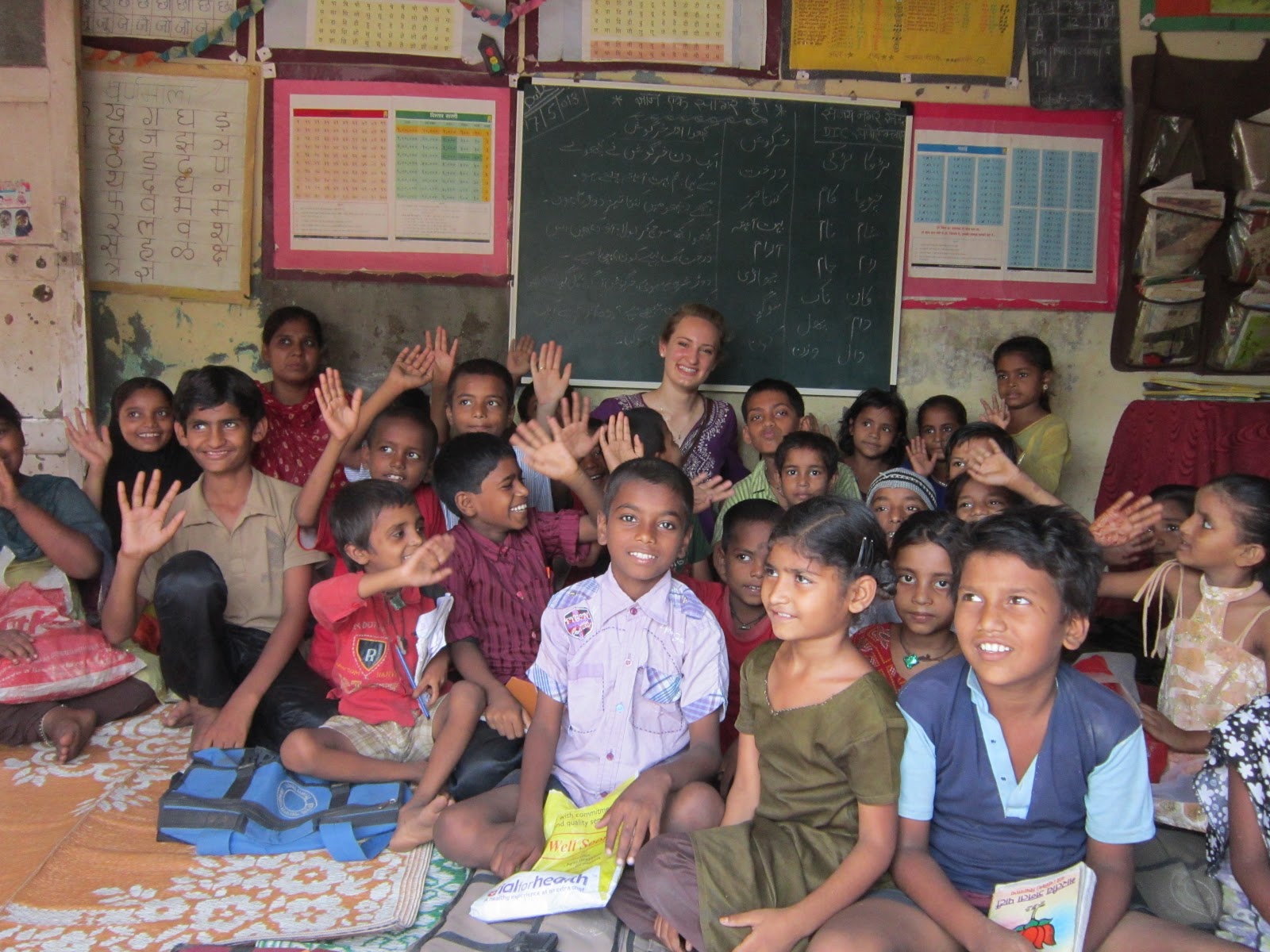
If children are found wondering around on the trash pile, or have simply dropped out of school, the Pratham staff enrolls them in a transitionary classroom that helps the children acclimate to the classroom atmosphere before they are put back into the government school system. Once the children enroll in the government schools, they are provided with educational support classes where they are helped with homework and receive extra academic attention.


visiting the children's classroom

Some girls showing us a dance they had learned